Be a Sponge
In one of the evolutions of Nike's core principles, Be a Sponge had a good run. On its surface being a sponge seems like a simple callout to know your environment before you act. It's a reminder to be patient and listen. Yet at the same time Nike also embraced Evolve Immediately as a maxim. If you're slowing down to listen, how exactly would you be able to immediately evolve?
A Well-Trodden Path
My journey into leadership followed a fairly well trodden path. One level removed I focused a little too much on the work of the team, struggling when someone dared do something differently than I might.
In my next phase I had let that direct control go, but not the worry. I still would feel the stress of every deadline - asking too many questions looking for a constant signal telling me that we'd be okay.
Then came the focus on the individual - if the team as a whole could be trusted, maybe I could help those that weren't living up to their potential. In this phase I took every individual failure as a personal failure. If someone wasn't meeting expectations I wasn't being a good leader.
Absent from these phases was the focus on the where and why. Some of that came from the challenge of working in a large enterprise. Your scope is often limited by organization structures and norms. The majority of my directional deficit was because I hadn't considered the work it would take to transition from focusing on doing to deciding on what needed to be done.
It wasn't that I didn't try to be an effective leader. I was reading books on team building, on spheres of influence, on being a multiplier. Those books were valuable resources but they focused on guiding execution in a compassionate and efficient manner. There didn't seem to be an Idiot's Guide to Rapid Decisioning in my local bookstore.
How a Gas Sensor Listens
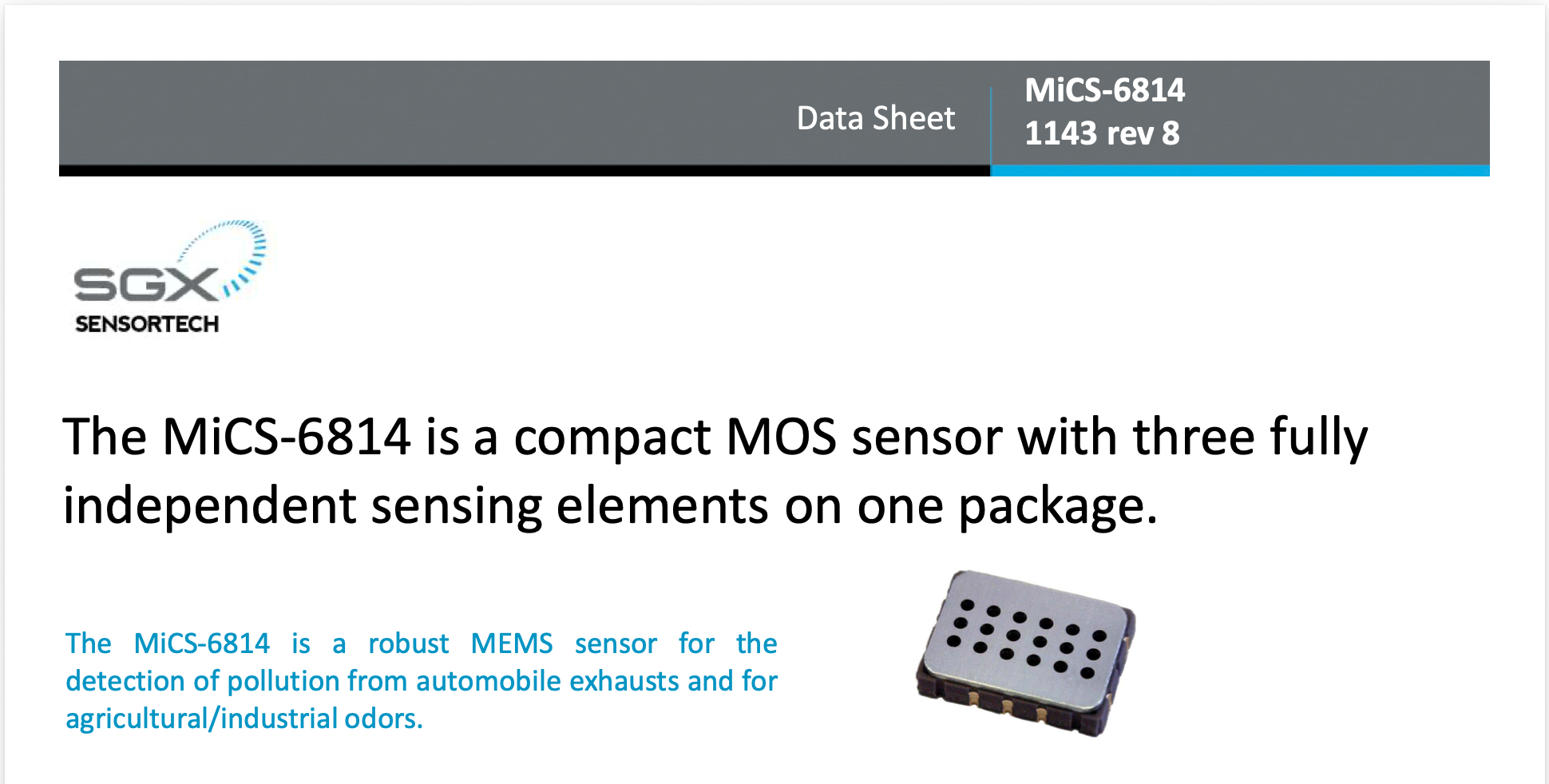
From the SGX Sensortech MiCS-6814 data sheet (1143 rev 8), reproduced for commentary; MiCS-6814 and SGX Sensortech are trademarks of their respective owner.
The MiCS-6814 MOS gas sensor is a fascinatingly simple but useful bit of technology. It detects the levels of gases like Carbon Monoxide, Ammonia, Nitrogen or Methane - basic pollutants from combustion. It measures changes in resistance across semiconductors when gas molecules interact with them. The greater the gas concentrations the larger the change in resistance.
The MOS sensor interprets its environment in real-time by actively absorbing and measuring signals. Being a Sponge never meant slowing down, it meant actively pulling in data. It was meant to unlock your ability to Evolve Immediately. Take what you saw, heard, read and run with it. Use your instinct to guide you; make sure you get there first.
Lashed to the Input
None of my instincts around leadership were inherently wrong. I over-indexed on measuring every aspect of the environment that I was responsible for. I was lashed to the capture of input, and untethered from the need to evolve. This is a very difficult transition for a developer; going from a hard line on "don't build it until the requirements are final" to a fluid "I hear a whisper of concern from team X, let's pull 2 from team Y and see if we can suss out a way forward".
The book I needed early in my leadership career would have guided me down the narrow path between finger-in-the-air to measure the wind and a full blown multi-gauge weather station. It would have been littered with mnemonics drilling home that leadership is about sampling and deciding in continual loops.
The thing most leaders won't readily admit, but the really good ones will, is that they're often wrong. Usually in small ways that can be quickly corrected when they are running in tight sample-decide loops. Sometimes however there are big misses that require uncomfortable resets. Evolution is messy, but if you embrace it you'll get what you need in the end.
The Sensors Are Your Team
To be a good leader you need to deploy a wide range of sensors to sample data in real-time. You need to wire up a harness to distill the raw data into something you can quickly interpolate. You need to decide, and then read the latest data to evaluate how your decision played out.
In the real world the sensors are your team and the harness is trust. It's the easiest thing to describe and one of the most challenging and rewarding things to do well. I don't know if there's a fast-pass to skip through the down-focused phases, but in the end if a leader can't shift into sample-decide both they and their teams will ossify and eventually fail.